
Start with a small area, a clear service and a reliable way to reply. Use local search, recommendations and permitted community posts to reach people whose lawns fit your equipment and working week. Then quote clearly, deliver the agreed work and ask about the next visit.
This plan works without a paid advertising budget. It gives you actions to test, not a promised customer count or search ranking. If you are still choosing equipment and setting up the business, use the lawn mowing startup guide alongside it.
Starting solo or adding work for a small crew? Use the same steps to find nearby customers you can serve well. Keep your budget and capacity in the business plan template.
Step 01
Decide which customers fit your working week.
Write down the neighbourhoods you can cover, the services you offer and the days you can work. “Mowing, edging and tidy-up for small residential lawns in these three suburbs” gives someone more to act on than “all garden services everywhere”. Only advertise work you can perform competently.
Choose a manageable first round. Nearby properties can make follow-up visits easier to schedule, while scattered jobs can consume your time in travel. Leave room for weather, maintenance and enquiries.
Set a customer target from the income you need, realistic visit frequency and the cost of delivering the service. A fortnightly customer is not a weekly paid visit, and seasonal mowing frequency varies.
Work out how many customers you need.
Use your own prices, costs and available hours to estimate a customer target. Check the workload before making it your goal.
Calculate your customer targetCheck the budget before growing the round.
Use the Startup Cost Calculator to budget for equipment, operating bills and a cash buffer. Then take annual overhead into your customer target.
Plan your startup budgetStep 02
Make your business easy to find and contact.
Follow the Google Business Profile walkthrough for lawn care businesses for a setup checklist, example and ways to measure enquiries.
For an eligible business, a Google Business Profile is one place to establish a local presence. Use your real business name, accurate services, opening hours and contact information. Complete verification when Google requires it and keep the details current.
If you travel to customers and do not serve them at your business address, use the appropriate service-area setup and hide that address. List areas you actually serve; do not invent offices or create a separate profile for every suburb.
See Google’s business representation guidelines and service-area guidance.
Use clear photographs of your own work with permission. Keep names, house numbers, people and other identifying details out of public photos unless you have appropriate permission. Make the next step obvious: a monitored phone number, enquiry form or business email.
Google says local results depend mainly on relevance, distance and prominence. Complete information helps Google understand the business, but no profile checklist guarantees a top position.
Step 03
Look for the next customer near the last one.
People who already know you
Explain your service area and availability to your own network. Ask them to pass on your business contact to someone who needs the service. Let that person choose to enquire.
Neighbourhood groups
Read the rules before posting. Use a brief introduction, genuine work photos and a clear contact method. Reply helpfully when someone asks for an operator; avoid repeated promotional posts and unsolicited private messages.
Customers and local relationships
After an agreed job goes well, mention that you have room for nearby work. Relevant local trades or property managers may also know people who need your service. Describe what you can deliver rather than promising availability you do not have.
Hand over a card people can use
Start with a small batch. Offer a card when someone asks about your work, or leave a few with a local business that agrees. Respect access restrictions and local distribution rules. Ask enquiries how they found you and count first paid visits before ordering more.
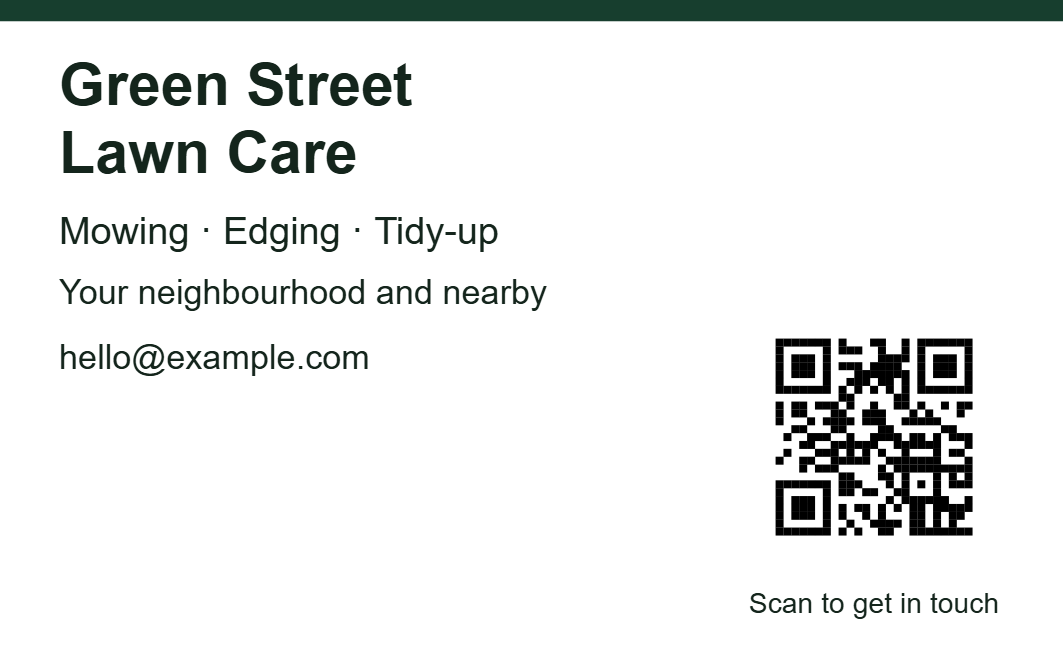
Fictional example. Add your own details.
You do not need every channel at once. Start with two you can maintain, record the time and money spent, and judge them by suitable work won.
Step 04
Make the quote easy to understand and accept.
Reply when you can give the enquiry proper attention. Confirm the location privately, the service required, lawn size, access, obstacles and clipping disposal. Ask whether it is a one-off or repeat service. Inspect the property when photographs or dimensions are not enough.
A useful quote states the scope, inclusions, price and tax treatment, plus any conditions or validity date. Explain when you can visit and how the customer can accept. Keep a preferred date provisional until you have agreed the booking.
Send a quote that matches your business.
Create a clear quote with your logo and colours, then print or save a PDF without signup. Choose “Save this quote in Runcina” when you want to manage the work in the app.
Create a quoteCheck the price before offering an introductory discount. Read how much to charge for lawn mowing and use the mowing price calculator to allow for setup, travel and costs.
Make it your own
Five examples you can copy and adapt.
Replace every bracketed detail and check the wording before using it. These examples do not send anything or collect customer details. Use the right channel and permission for the situation; a previous job does not automatically grant permission for all future marketing.
For Australian email and text marketing, check consent, sender identification and unsubscribe requirements in ACMA’s guidance. Elsewhere, follow the applicable local rules. These examples are conversation starters, not a complete compliance template.
Step 05
Earn the second visit and agree the next one.
Deliver the scope you quoted, communicate changes and leave the property as agreed. After the first visit, ask whether the customer wants a regular service and what frequency suits the lawn and season. Confirm the arrangement rather than automatically adding them to a recurring round.
Ask for honest reviews after genuine customer experiences, where contact is permitted. Use the review link provided by Google. Do not offer discounts or free work for a review, or ask only people you expect to leave a positive rating.
Read Google’s review guidance.
Put agreed visits into a workable round.
Use the eight-week planner to check workload and recurring visits before saving your plan. Read the recurring mowing guide for keeping repeat work organised.
Plan your recurring visitsIf you are considering buying established work alongside finding new customers, use the mowing business buyer’s checklist to assess the customers and handover.
Step 06
Count paying customers, then check the work is worthwhile.
Keep a simple private lead log: date, source, area, requested service, quote status and next agreed action. Record the first paid visit and any confirmed repeat arrangement. Ask “How did you hear about us?” and allow “unknown”; do not guess the source.
Compare each channel’s enquiries, quotes, first paid customers and repeat customers. Track cash spend and your own time separately. Followers and post views can help explain reach, but they are not booked or paid work.
A small example: what did a customer cost?
Suppose an operator spends AUD 60 on a local flyer trial. Six people enquire, three accept a quote and two have completed and paid for their first visit so far.
- Cash spent on this trial
- AUD 60
- First paid customers so far
- 2
- Cash acquisition cost per first paid customer
- AUD 30
AUD 60 ÷ 2 = AUD 30. This fictional example excludes design, distribution and follow-up time. It is not a predicted return. Review the third accepted quote later; do not count it as paid yet. If there are no paid customers, report zero and the spend so far rather than dividing by zero.
Next, use the job profit calculator to check what the visits leave after labour, travel and other costs. Acquisition spending must be counted once in your overall business assessment. A cheap lead for an unprofitable, distant job may be less useful than a nearby regular customer.
Keep the customers you win organised.
Use a separate lead log for enquiries. Once work is agreed, organise customer and property records with the spreadsheet template. Check the file locally, then choose import review when you want to bring actual work into Runcina.
Get the customer spreadsheetSmall actions, one working month
Your 30-day customer-acquisition checklist.
Adjust the pace to your hours and local season. Tick actions as you complete them. The selections stay on this page and are not saved by Runcina.
Days 1–7: make it easy to choose you
Days 8–14: start local conversations
Days 15–21: turn interest into agreed work
Days 22–30: build the repeat round
Runcina · 30-day lawn care customer plan · 7 November 2026
https://runcina.app/how-to-get-lawn-care-customers
A plan to test and adapt. Customer numbers and results vary.
Finding regular lawn mowing customers
Focus on households and properties you can service reliably within your existing area. Ask whether they need a one-off cut or regular mowing, confirm what each visit includes, and agree the price and frequency before adding them to your schedule. A nearby recurring customer can fit your round more easily than a distant job with the same price.
Common questions about getting lawn care customers.
How do I get customers with no advertising budget?
Start with an accurate eligible business profile, your existing network and community groups that allow business posts. Offer a clear service in an area you can cover. These routes still take time; record the effort and which enquiries become worthwhile work.
What if I have no customer photos or reviews?
Describe your actual services and experience honestly. You can show suitable work on your own lawn or a permitted practice job, clearly labelled as such. Build customer examples after genuine work with permission. Do not invent testimonials or imply practice work came from a paying customer.
Should I offer the cheapest mowing price?
Price the scope and time you need to deliver reliably. If you test an offer, define its terms and confirm it still covers your costs. Clear communication, dependable visits and suitable availability give people reasons to choose you beyond price.
How many customers should I aim for?
It depends on price, visit frequency, season, costs and capacity. Use the income and customer-target calculator with your own assumptions, then check the visits fit your week.
Should I buy ads straight away?
First make sure you can respond, quote and deliver the work. Once you can track a lead through to a paid visit, a small budget-limited trial is easier to evaluate. Review the quality and profit of the work before increasing spending.
Know someone building a mowing round?
Share this guide, the message examples and the 30-day checklist with your operator group.
For Messenger or another group, use Share or paste the copied link. Sharing includes only the public guide link, never your checklist selections.
Sources and next steps.
Published by Runcina, software for mowing and lawn care businesses to manage customers, quotes, jobs and invoices. The actions and message examples are practical suggestions to test; the AUD figures are illustrative. This is not a promise of leads, income or rankings.
The official Google and ACMA references linked above were checked on . Platform requirements can change and marketing rules depend on location. For a broader planning framework, see business.gov.au’s marketing-plan guidance.
Explore the free tools or follow the Runcina setup guide when you are ready to manage your first customers and jobs.
Make the next quote clear
When an enquiry is ready for a price, use a mowing quote or estimate template to explain the scope and next step. You can also customise the wording in the online Quote Generator.